Key takeaways
AI marketing is an operating model, not a tool. The brands running it well grow 2.3x faster and run on 40% lower marketing headcount than peers without it.
AI marketing got buzzword-flattened in 2023. Every vendor stamped AI on the homepage. Every analyst published a report. Most operators tuned out and went back to the work. Two years later the operating gap between brands using AI well and brands ignoring it has become impossible to hide. This piece names what AI marketing actually is, where it pays back, and where it is still hype.
What is AI marketing in practice?
AI marketing refers to using machine learning, large language models, and predictive analytics across the marketing stack to do better targeting, creative, automation, and measurement at higher speed and lower cost.
The adoption data is mature. HubSpot 2026 State of Marketing reported 79% of marketers use AI in at least three workflows, up from 21% in 2023. McKinsey research on 1,400 enterprises put the marketing productivity lift from AI at 30 to 45% for top-quartile adopters. And Salesforce 2026 data shows AI-using marketing teams report 2.3x higher revenue growth than non-users over a 12-month window.
Search is where AI marketing meets the customer. Backlinko research shows AI search referrals from ChatGPT, Perplexity, and Google AI Overviews now account for 13 to 19% of B2B discovery traffic, up from under 2% in 2023. Profound data confirms the trajectory, with AI referrals growing 4% per quarter.
Where does AI marketing actually pay back?
AI marketing pays back fastest in four areas: creative production, automation triggering, attribution and forecasting, and content production for SEO and GEO together.
Creative production: tools like Pencil and Creatify produce 4 to 7x more variants at similar win rates. Automation triggering: behavioral models lift Klaviyo and HubSpot flow revenue 30 to 60%. Attribution and forecasting: Northbeam, Measured, and Triple Whale produce holdout-accurate ROAS for the first time at mid-market budgets. Content: Claude, Frase, and Surfer let a four-person team ship 16 to 24 pieces per month with strong rankings.
Where is AI marketing still hype?
AI marketing is still hype in fully autonomous campaigns, AI-only content, and most chatbots, where the technology is not yet good enough to remove humans from the strategy.
Fully autonomous campaign management (Meta Advantage+, Google Performance Max with no human input) produces 12 to 22% worse results than human-supervised versions on most accounts according to Tinuiti benchmarks. AI-only content underperforms human-edited content by 38% in Ahrefs ranking research. Most chatbots still annoy customers more than they help. The pattern is consistent: AI as assistant works, AI as replacement does not.
Which AI marketing tools are worth paying for in 2026?
The AI marketing tools worth paying for in 2026 are the ones that accelerate a clear human workflow, not the ones that promise to replace the workflow entirely.
- Claude or ChatGPT Enterprise for content drafting, briefing, and analysis across the stack.
- Pencil or Creatify for AI-assisted ad creative production at scale.
- Northbeam, Measured, or Triple Whale for AI-powered attribution and incrementality testing.
- Mutiny or Intellimize for AI-driven web personalization on identified visitors.
- Klaviyo AI or HubSpot Breeze for behavior-triggered email and lifecycle automation.
- Frase or Clearscope for AI-supported SEO and GEO content briefs that score against the SERP.
How does GEO change the AI marketing playbook?
Generative engine optimization refers to making content discoverable inside ChatGPT, Perplexity, and Claude search, which requires structured answers, named sources, and clean schema.
AI search rewards specific things. Princeton GEO research found content with named sources and structured Q&A appears in AI answers 3.4x as often as unstructured content. OpenAI search and Perplexity both confirm preference for content with clear citation patterns. Schema.org BlogPosting and FAQPage structured data ship with our Booming Venture sites by default for this reason.
What does an AI-fluent marketing team look like in 2026?
An AI-fluent marketing team in 2026 has four to six people doing the work of 10 to 14 in 2022, with AI assistants embedded in every major workflow and clear human ownership of strategy.
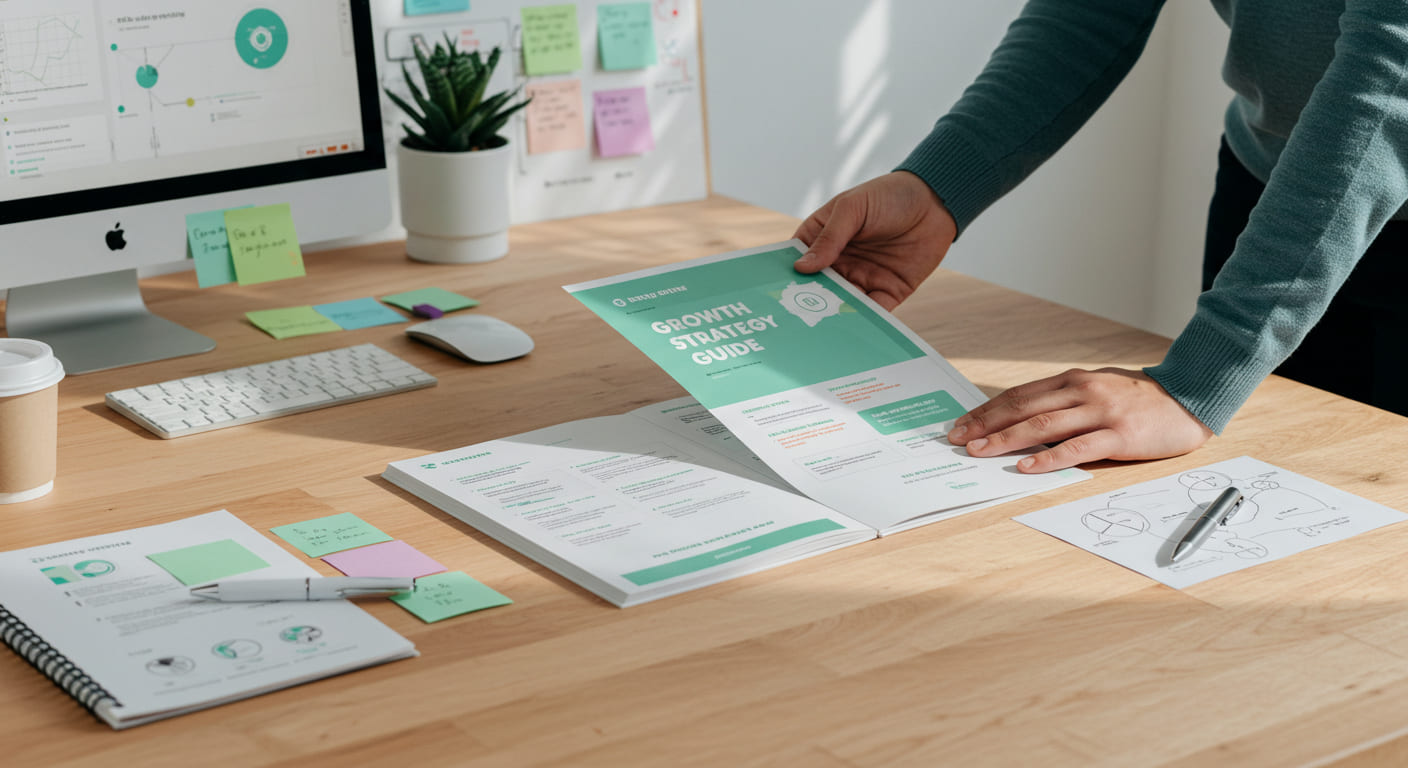
Head of growth, head of content, performance analyst, creative producer, lifecycle owner. Five people, AI stack underneath, 2 to 3x the output of a 2022 team at 40% the headcount cost. The model is real, the brands running it are visible, and the gap to those who have not adopted is widening every quarter. Run a Boardroom Quickscan or download the Free Growth Guide to see where to start.
Governance is the part most teams skip. AI marketing introduces real risks: data leaving the company through the wrong tool, customer PII flowing into models that retain it, brand-voice drift across hundreds of AI-assisted touchpoints. The fix is policy plus tooling. Pick enterprise versions of the AI tools (Claude Enterprise, ChatGPT Enterprise) that contract not to train on your data. Write a 500-word AI usage policy covering what data goes where. Audit AI-generated outputs monthly for brand voice and factual accuracy. EU AI Act compliance now requires documentation of AI use in marketing for European-facing brands, which makes the policy work non-optional rather than a nice-to-have.
Budget allocation also shifts. The 2026 marketing budget for an AI-fluent team typically allocates 18 to 25% to tools (up from 8 to 12% in 2022), 30 to 38% to media (down from 45 to 55%), and 38 to 48% to people (down from 35 to 42%). The shift is not arbitrary. Tools replace one to two FTEs of execution. Media gets more efficient per dollar through AI-powered targeting and creative. People remain the strategic core but at smaller headcount with higher individual output. The brands locked into 2022 ratios are paying 30 to 50% more for similar output. McKinsey analysis suggests the ratio gap will widen another two to three years before flattening.
Skills matter more than tools. The 2026 marketer needs prompt design fluency, data interpretation, and clear writing as the three core capabilities. LinkedIn B2B Institute research on marketing job postings shows roles requiring AI prompt design grew 340% between 2023 and 2026, while roles requiring manual campaign execution declined 28%. The hiring profile is shifting from execution to direction. The teams investing in skills training today, even informal weekly sessions, are pulling ahead of teams waiting for formal courses or certifications. The window to build this fluency inside an existing team is open for another 18 to 24 months before the cost of catching up becomes prohibitive.
Frequently asked questions
Is AI marketing only for big brands?
No. Mid-market brands and even early-stage startups benefit most because AI compresses the team size needed to run a credible program.
Will AI replace marketing jobs?
It will reshape them. Brief writers, editors, analysts, and strategists become more valuable. First-draft writers and manual campaign builders become less valuable.
What is the fastest way to start with AI marketing?
Pick one workflow (content production, ad creative, or email automation), introduce one AI tool, measure for 90 days, then add the next.
How do we measure AI marketing ROI?
Always against a holdout. Most platform-reported lifts are gross. Real ROI requires comparing AI-assisted output to a comparable human-only baseline with proper measurement.
Will AI marketing change again in 2027?
Yes. The next shift is agentic workflows that run multi-step processes without human checkpoints. The brands building AI fluency now will adopt those workflows two years ahead of peers.
Want it done with you? Book a free UNIFY audit.